Agentic commerce on Shopify: what it means for your brand
A practical guide to agentic commerce on Shopify. Learn what Shopify Catalog and agentic storefronts do, why product data is now an AI visibility lever, and how Glara helps you track, optimize, and measure product-level recommendations.
Glara Team
|
If you have been paying attention to the Shopify admin recently, you may have noticed some new settings appearing under Sales Channels. Or you may have seen the announcements about ChatGPT, Google AI Mode, and Microsoft Copilot now surfacing Shopify products directly inside conversations. This is not a minor update. It is a structural shift in how product discovery works, and it has direct implications for how you manage your catalogue.
This post explains what agentic commerce actually is, what Shopify has built to support it, and why the quality of your product data now determines whether you show up and get picked, or get passed over entirely.
What agentic commerce actually means
In traditional ecommerce, a shopper has a need, opens a browser, searches for a product, lands on a page, and decides whether to buy. The brand’s job is to get in front of that shopper at the right moment and convert them when they arrive.
Agentic commerce changes the sequence. Instead of a shopper navigating to a store, an AI agent does the research on their behalf. The shopper asks a question in ChatGPT, Google AI Mode, or Microsoft Copilot, something like “find me light running shoes I can use for trail running, under €150”, and the AI surfaces relevant products, answers follow-up questions, and guides the shopper through to purchase, often without them ever visiting a brand’s website directly.
Since January 2025, AI-driven traffic to Shopify stores has grown 8x year on year, and orders from AI-powered searches have increased 15x. This is already happening at meaningful scale, and the infrastructure Shopify has built around it is designed to accelerate it further.
What Shopify has built: the three layers
Shopify’s approach to agentic commerce has three components that work together.
Shopify Catalog This is the structured data layer that makes your products readable to AI agents. Shopify Catalog takes your product information, including titles, descriptions, pricing, inventory, and shipping details, standardizes it into a universal taxonomy, and syndicates it in real time to every connected AI platform. For merchants, products are listed in Catalog by default, and any updates made in admin are reflected automatically across all AI channels.
Shopify also uses machine learning to infer additional product attributes from your data and from cross-merchant purchase signals. A product listed under “home accessories” might be identified as a popular Mother’s Day gift based on purchase patterns across millions of transactions, making it more likely to surface for relevant queries. The key phrase here is that Catalog generates these inferred fields based on the product data you provide. Better input data produces stronger inferred output.
Agentic Storefronts This is the sales channel in your Shopify admin that connects your products to the AI shopping platforms. It is automatically activated for eligible merchants and requires no additional apps or integrations. Supported platforms currently include ChatGPT, where shoppers complete checkout on your own store via an in-app browser, Microsoft Copilot, and AI Mode in Google Search and Gemini, where checkout can be completed directly inside the conversation via Shopify’s infrastructure.
All of this is currently available to merchants selling to US buyers. Global rollout is underway as AI partners expand to additional markets.
Knowledge Base This is a Shopify app that lets you control what AI agents say about your brand beyond product recommendations. Return policies, shipping information, brand voice guidelines, FAQs. When a shopper asks an AI agent “does this brand offer free returns?” the agent references your verified answers rather than guessing or scraping outdated information from your site. As AI conversations increasingly replace the browsing behaviour that used to bring shoppers to your policy pages, having accurate answers at the point of the AI conversation matters more than having them buried on your website.
The Universal Commerce Protocol: why this scales
Each AI platform has a different interface and a different approach to commerce. Without a shared foundation, every new platform would require its own custom integration, and merchants would have to build and maintain separate cart logic, checkout flows, and payment handling for each one.
The Universal Commerce Protocol, or UCP, solves this. Co-developed by Shopify and Google, and backed by Amazon, Microsoft, Stripe, Visa, Mastercard, Meta, Salesforce, Walmart, and others, UCP is an open standard that defines how AI agents transact with merchants across any platform. A merchant’s checkout rules, discounts, and terms work consistently regardless of which AI agent initiates the interaction. That means as soon as a new AI platform adopts UCP, Shopify merchants are automatically ready to sell there with no additional setup required.
For ecommerce teams, the practical implication is that the number of AI surfaces where your products can appear will keep growing. The question is whether your product data is good enough to show up well across all of them.
Why your product data is now the primary lever
Here is the part that requires the most attention. Shopify Catalog automatically structures and syndicates your data, but it cannot create quality attributes from thin or incomplete source data. Think of it as: good data in, good data out.
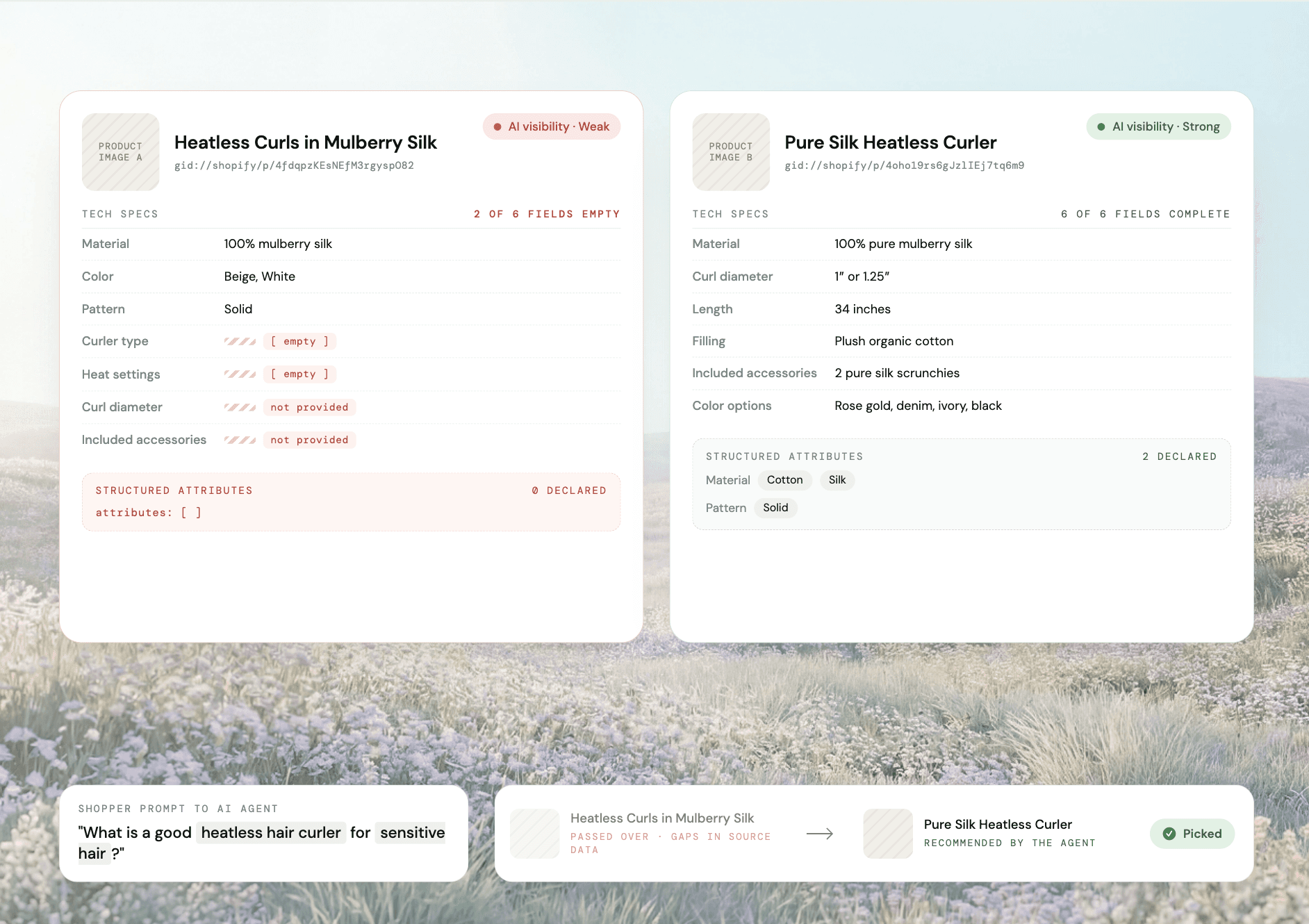
To make this concrete, here is a real example from the Shopify Catalog. Two products in the same category, a heatless silk hair curler, appearing very differently in the Catalog feed.
Product A has a title, a basic description, material listed as 100% mulberry silk, color as beige and white, and pattern as solid. The curler type field is empty. Heat settings are empty. Attributes are empty.
Product B has a specific title including the color variant, a description that specifies the silk thickness at 23 momme, a unique selling point that references the certification and gentleness for all hair types, top features that call out the accessories included, and tech specs that include silk thickness, diameter, curler type listed as heatless, and the included accessories in detail.
When a shopper asks an AI agent “what is a good heatless hair curler for sensitive hair,” both products are in the same category. But Product B gives the AI agent specific, verifiable attributes to match against the query, while Product A leaves the agent with gaps it cannot fill. Product B gets recommended and Product A gets passed over.
Same product. Different data. Different outcome.
Two heatless silk curlers, same category in Shopify Catalog. Here’s what the AI agent actually sees and why only one gets recommended.
This is not a hypothetical. It is what is happening inside Shopify Catalog right now, and it is the difference between your products showing up in AI recommendations and your competitors showing up instead.
What Shopify’s Catalog does and does not do
A common question the Glara team is hearing from merchants is: if Shopify Catalog automatically enriches my product data with AI, why do I need to worry about optimization at all?
The answer is that Shopify Catalog generates structured fields based on the product information you have already provided, combined with cross-merchant signals from Shopify’s transaction data. It cannot invent attributes that do not exist in your source data. If your product description does not mention the curler type, Catalog cannot reliably populate that field. If your fabric composition is buried in a paragraph of lifestyle copy rather than stored as a clean attribute, Catalog’s ability to generate accurate structured fields is limited.
The relationship works like this: Glara’s Optimizations Agent improves the product data in your Shopify store, including catalogue-specific optimizations aligned to the fields and taxonomy Shopify Catalog uses, and Shopify Catalog then reads that improved data and generates stronger structured fields for AI agents to use. Better source data in Shopify produces better Catalog output, which produces stronger AI recommendations.
Glara does not replace what Shopify Catalog does, it improves the input that Shopify Catalog works from.
Where Glara fits in the agentic commerce stack
Glara operates at the product data layer, which is exactly the layer that determines Catalog quality and therefore AI recommendation quality.
Tracking: Glara monitors how your products appear across ChatGPT, Gemini, and other AI assistants at product and SKU level. You can see which products are being recommended, which are absent, and how your visibility compares to direct competitors in your vertical.
Optimization: Glara’s Optimizations Agent identifies the specific gaps in your product descriptions, structured data, and meta tags that are limiting your Catalog quality and AI visibility. This includes catalogue-specific optimizations: improving the fields, attributes, and taxonomy that Shopify Catalog reads when generating the structured data AI agents use to recommend your products. It generates the fixes and pushes them directly to your Shopify store via API once your team reviews and approves them. Every change is reversible.
Measurement: Glara connects AI visibility data directly to Shopify, Google Analytics, and Google Search Console, so you can see which AI recommendations are translating into actual traffic and sales rather than just tracking citation rates as an abstract metric.
As the lever in agentic commerce shifts from “is my site crawlable” to “is my Catalog data good,” Glara is the tool that improves the data quality that everything else depends on.
What to do now
If you are a Shopify merchant, your products are likely already in Shopify Catalog and appearing, to some degree, across the AI shopping channels. The question is whether they are appearing well enough to be recommended over competitors.
A few practical starting points:
Check your Agentic Storefronts settings in your Shopify admin under Settings, then Sales Channels. Confirm which channels are active and whether direct checkout is enabled for Copilot and Google AI Mode. Audit your top SKUs in Shopify Catalog. The best way to see exactly how your product data looks to an AI agent is to check the Catalog feed directly. Look for empty fields, missing attributes, and generic descriptions that are not giving the AI enough to work with.
Consider what is missing at variant level. The most common gap in Catalog data is not at product level but at variant level. Color, size, material, and specific product attributes need to be present for each variant, not just the parent product.
Install Knowledge Base. If you have not already, setting up verified answers for your most common customer questions ensures AI agents are representing your returns policy, shipping information, and brand accurately at the point where shoppers are making decisions.
The bigger picture
Agentic commerce is not a feature update. It is a shift in where product discovery happens. The shopper journey that used to start with a Google search or a social scroll is increasingly starting with an AI conversation, and the brands that appear in those conversations are the ones whose product data is clean, specific, and structured for AI retrieval.
Shopify has built the infrastructure to connect your products to that new layer of discovery. Glara helps you make sure the data feeding that infrastructure is strong enough to compete.
Want to see how your products are appearing in AI recommendations right now, and what your Catalog data looks like to an AI agent? Create your account and Glara will show you exactly where the gaps are. Or start your free 7-day trial and see it in your own dashboard.

Create an account to track your AI visibility and start your 7-day free trial once setup is done.