AI visibility for beauty brands on Shopify: the complete guide to getting your products recommended in 2026
La Roche-Posay leads the May 2026 beauty AI leaderboard with a 17.5% mention rate. What separates the brands AI recommends consistently from those that rarely appear is not marketing spend. It is product data specificity. This post covers exactly which signals drive beauty recommendations and how to close the gaps.
Glara Team
|
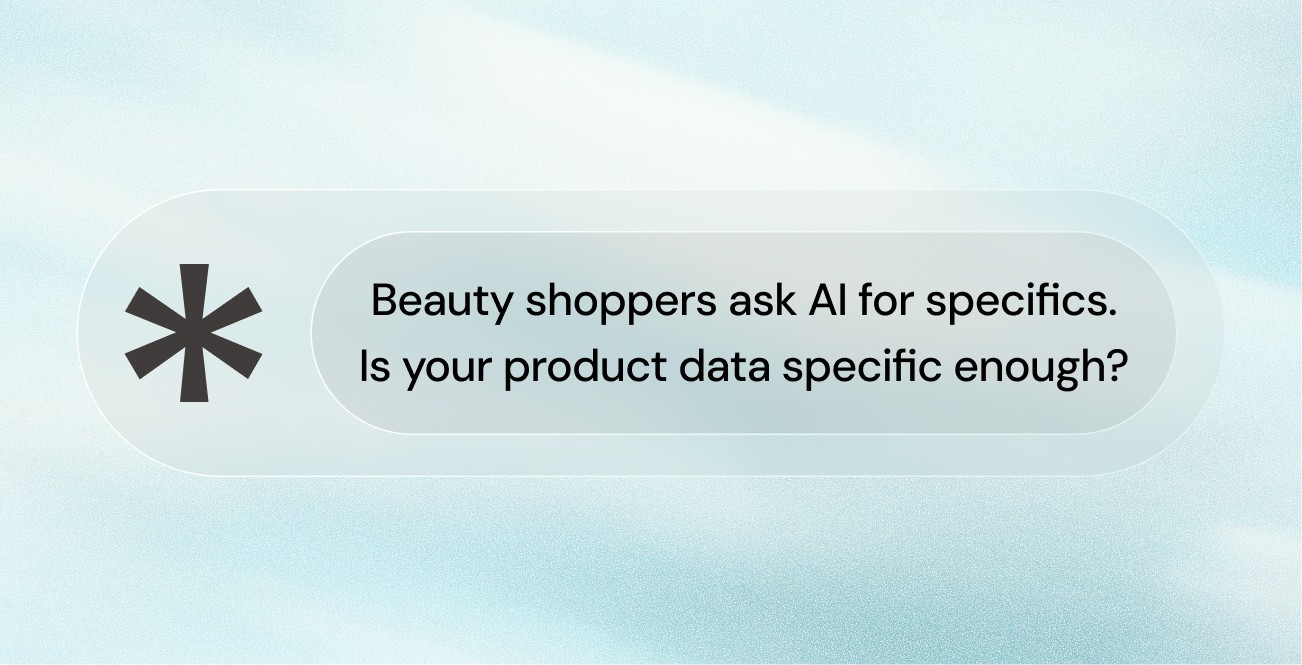
Beauty is one of the most active categories in AI search. Shoppers asking ChatGPT or Perplexity for skincare recommendations are not making casual queries. They are describing their skin type, their concerns, their budget, and their existing routine, and they expect the AI to give them a specific, credible answer. The brands that appear in those answers consistently are the ones whose product data is precise enough for AI agents to match against detailed, multi-attribute queries.
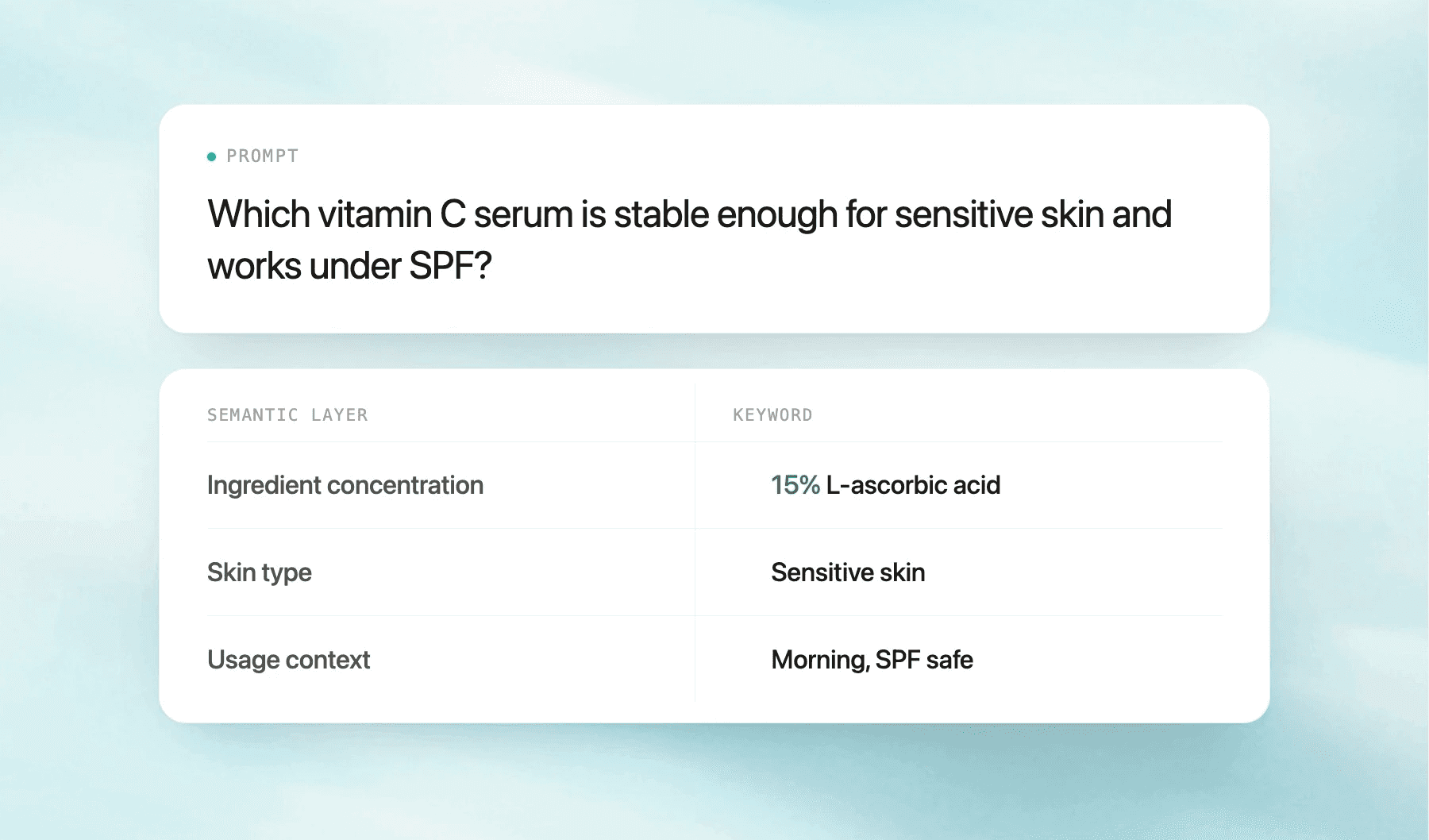
For beauty and skincare brands, this is both a significant opportunity and a practical challenge. The queries driving AI recommendations in beauty are increasingly specific: “fragrance-free SPF moisturiser for sensitive skin that works under makeup”, “retinol alternative for beginners with dry skin under £50”, “vitamin C serum with at least 15% concentration that is stable and non-irritating”. These are not keyword searches. They are shopping briefs, and the brands that win them are the ones whose product content is structured to answer them.
Glara tracks AI visibility across beauty brands every month. In May 2026, La Roche-Posay leads the beauty leaderboard with a 17.5% mention rate across AI assistants, followed by CeraVe at 11.4% and Eucerin at 8.9%. What those brands have in common is not marketing budget. It is product content that gives AI agents enough specific, verifiable information to recommend them with confidence. You can see the full leaderboard and sign up for your own free brand report here.
Why beauty queries demand more from product data
Beauty shoppers are among the most research-intensive in ecommerce. Concerns about skin reactions, ingredient interactions, and suitability for specific skin types mean that purchase decisions are rarely made on a brand name alone. A shopper asking an AI assistant for a recommendation is typically looking for validation that a product is right for their specific situation, not just a list of popular brands.
AI agents responding to those queries are doing something similar to what a knowledgeable friend or beauty editor would do: they are trying to match a product to a person based on specific criteria. To do that well, they need product data that is specific about ingredients, skin type suitability, texture and finish, certifications, and use case context.
Most beauty product pages are written for human appeal. They use sensory language, lifestyle imagery, and brand storytelling to create desire. That copy does useful work for human shoppers, but it does almost nothing for an AI agent trying to match a product to a query that contains specific skin type, ingredient, and occasion criteria.
The result is that products that would be a perfect match for high-intent queries do not appear in AI recommendations, while competitors with less elegant copy but more structured product data show up consistently. This is the same pattern we discuss in our post on what makes a product page AI-ready, where the difference between being retrieved and being recommended comes down almost entirely to how explicitly the product attributes are stated.
The attributes that drive AI recommendations in beauty
Glara tracks AI visibility across beauty brands on Shopify and the same attribute gaps appear consistently. The signals that most reliably drive AI recommendations in this category are:
Ingredient specificity Key active ingredients with their concentrations where relevant, hero ingredients named explicitly rather than implied, and ingredient lists that are present in structured data rather than only in the product description. A product described as “enriched with vitamin C” is less citeable than one described as “15% L-ascorbic acid with ferulic acid for enhanced stability”. AI agents need the specific form and concentration to match a product to ingredient-driven queries, which represent a significant share of high-intent beauty searches.
Skin type and concern suitability Explicit skin type suitability, named concerns the product addresses, and skin conditions it is suitable or unsuitable for. “Suitable for all skin types” is the least useful phrase in beauty product content. “Dermatologist-tested for sensitive, reactive, and rosacea-prone skin” is the kind of specific claim AI agents can match to queries with confidence. This is consistent with what our research on how AI search behaves across product categories shows: dermatologist is one of the most frequently added terms in AI background searches for skincare, appearing in 48% of grounded skincare prompts even when shoppers never wrote it. [link to how AI search behaves across product categories]
Finish, texture, and sensory attributes Lightweight, matte, dewy, non-comedogenic, fast-absorbing, oil-free. These are the attributes beauty shoppers include in queries and the ones that differentiate products within the same category. They are frequently present in marketing copy but missing from structured product attributes where AI agents can actually retrieve them.
Certifications and ethical credentials Cruelty-free, vegan, dermatologist-tested, fragrance-free, hypoallergenic, organic certification. In beauty, these credentials are increasingly important citation signals. AI agents cite products with named certifications with more confidence than those with generic ethical claims. The certification needs to be present in structured product data at individual product level, not just referenced in brand marketing.
Routine and usage context Morning or evening use, layering order in a routine, SPF suitability for daily wear, compatibility with active ingredients. The more specific the usage context, the more query types a product can be matched to. A moisturiser described as “suitable for use under SPF and makeup, morning and evening” matches a significantly wider range of queries than one described as “daily moisturiser”.
What a strong beauty product description looks like to an AI agent
To make this concrete, here is the difference between a typical beauty product description and one that is structured for AI retrieval.
A weak version reads: “Our bestselling vitamin C serum. Brightening, radiant-boosting, and suitable for daily use. A cult favourite for glowing skin.”
An AI agent retrieving this page finds a product called a vitamin C serum, but it does not know the concentration, the form of vitamin C used, which skin types it suits, whether it is fragrance-free, or how it fits into a routine. For a query like “stable vitamin C serum for sensitive skin under £40”, this product does not exist in the recommendation set.
A strong version reads: “15% L-ascorbic acid vitamin C serum with ferulic acid and vitamin E for enhanced stability. Fragrance-free and tested for sensitive skin. Use in the morning before SPF. Suitable for all skin types including sensitive, combination, and oily. Absorbs quickly without residue. RRP £35.”
For the same query, this product is a confident match across concentration, stability, sensitivity suitability, price, and routine context. That is the difference product data specificity makes in AI visibility.
The large catalogue challenge
Beauty brands with large catalogues face a specific challenge in AI visibility. The sheer volume of SKUs, particularly across multiple ranges, skin concerns, and shades, means that maintaining complete, specific product data across the whole catalogue is resource-intensive.
The temptation is to prioritize hero products and leave the wider range with thinner content. For AI visibility, that approach creates a significant gap. AI recommendations in beauty are often for specific use cases and skin concerns that are not served by hero products alone. A brand’s hero moisturiser might be well-optimised and appearing consistently for its core queries, while the rest of the skincare range is largely invisible because the product data is incomplete.
Glara audits beauty catalogues at SKU level, showing which products have strong AI visibility for their core queries and which have gaps in the attributes that are limiting recommendations. The audit covers ingredient specificity, skin type and concern suitability, structured data completeness at variant level, and review schema accessibility, the same four areas where beauty brands most consistently fall short. Glara’s Optimizations Agent then generates the specific fixes across product descriptions, structured data, and meta tags, prioritized by revenue relevance and pushed directly to your store once the team reviews and approves them. Every change is reversible. For a large beauty catalogue, that systematic weekly workflow is the difference between optimization being a project that never gets finished and a compounding habit that builds AI visibility over time.
Cross-platform consistency in beauty
Beauty is a category where shoppers frequently research across multiple AI platforms before making a purchase. A shopper might ask ChatGPT for a general recommendation, check Perplexity for more detail and citations, and then search Google to see AI Overviews before deciding. If your brand is described differently across those three platforms, or is missing from one of them, the shopper’s confidence in your product is reduced.
The divergence happens because different AI platforms draw on different sources and give different weight to different signals. ChatGPT’s view of a beauty brand might emphasize its founding story and hero products based on historical editorial coverage. Perplexity’s view might focus on ingredient credentials because those are what appear most in the sources it retrieves. Google AI Overviews might surface a specific product category based on what ranks well organically. This cross-platform fragmentation is covered in more detail in our post on why ChatGPT, Perplexity, and Google describe your brand differently.
Glara tracks your brand’s visibility and description across AI platforms at product and SKU level, showing specifically where the stories diverge, which products are affected, and what signals are driving the inconsistency. For beauty brands where cross-platform consistency is directly linked to purchase confidence, that view is an important part of the picture, and the Optimizations Agent generates the fixes that close the gaps rather than just surfacing them.
Connecting beauty AI visibility to revenue
The commercial case for AI visibility investment in beauty is straightforward once you look at the data. AI-referred visitors in beauty arrive having already matched the product to their specific skin type, concern, and criteria. They are not comparing products. They are confirming a decision. That translates to higher conversion rates and higher average order values than most other traffic sources.
Glara connects AI visibility data directly to your store and Google Analytics, so you can see which beauty products are generating AI-referred sessions, what those sessions convert at, and what the revenue contribution looks like at SKU level. For beauty brands building the case internally for this work, our post on how to give your ecommerce CMO a clear view of AI search contribution to revenue covers the reporting framework and the attribution model in detail.
The brands building strong AI visibility in beauty now are establishing citation authority that compounds as AI search scales. La Roche-Posay, CeraVe, and Eucerin lead the current Glara leaderboard not because they outspend their competitors on marketing but because their product content gives AI the clearest, most verifiable signal to work with. For independent and mid-market beauty brands, that is a gap that product data quality can close.
Curious how your brand compares to others in the beauty category? See the latest AI visibility leaderboard and sign up for your own free brand report here.
Want to see which of your beauty products are appearing in AI recommendations and which have content gaps worth closing? Create your account and Glara will show you exactly where your catalogue stands. Or start your free 7-day trial and see it in your own dashboard.

Create an account to track your AI visibility and start your 7-day free trial once setup is done.