Google AI Max for Shopping: the product data advantage
AI Max is expanding from Search to Shopping, and the brands that will benefit most are not the ones with the biggest budgets. They are the ones whose product data was already built correctly. This post explains what AI Max actually does, which attributes matter most, and why the same product data work that drives organic AI visibility also drives AI Max performance.
Glara Team
|
Google AI Max is coming to Shopping. It has been live on Search campaigns for over a year and the results are significant enough that its expansion to Shopping is worth paying close attention to now, before it lands.
The brands that will see the strongest uplift from AI Max are not the ones with the biggest paid budgets or the most sophisticated campaign structures. They are the ones whose product data foundations were already built correctly. AI Max does not create performance. It surfaces the performance that was always latent in your product data and amplifies it.
For ecommerce brands already thinking about AI visibility and GEO, this is not a new problem. It is the same problem showing up in a new paid surface.
What AI Max actually does differently
Traditional Shopping worked on a relatively simple principle. Your product title was effectively your keyword strategy. You did not bid on keywords, but you controlled how your products matched to queries by controlling what your titles said. The title was the dominant signal.
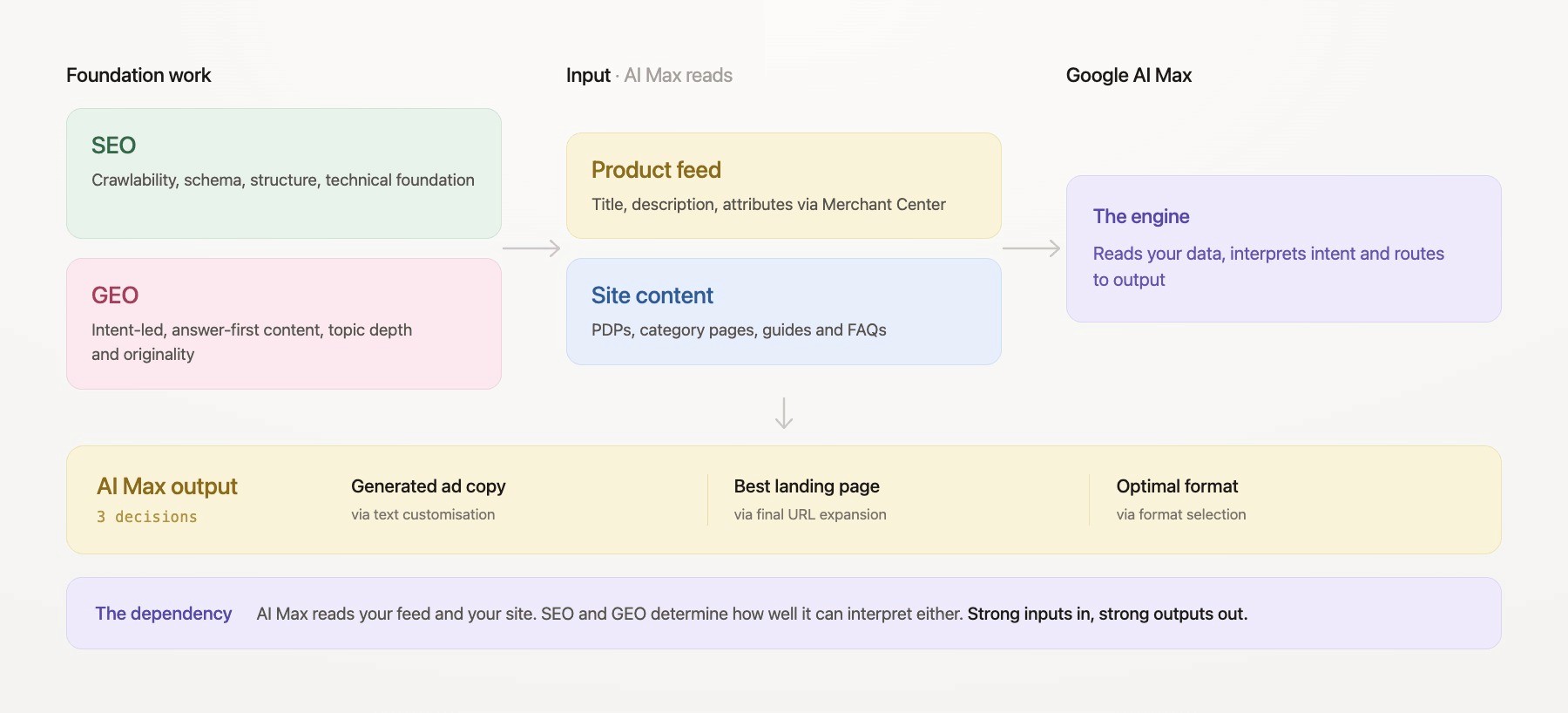
AI Max changes that fundamentally in three ways.
Text customisation means Google generates ad copy on the fly, drawing from your Merchant Center feed, your existing ads, and your landing pages. You provide the raw material. Google writes the ad. If the raw material is thin or generic, the output will be too.
Final URL expansion means Google chooses the best landing page for a given query, not necessarily the one you set as the destination. If a category page or a buying guide is a better match for the shopper's intent than the specific product page you pointed to, Google routes traffic there instead.
Optimal format selection means Google dynamically decides whether a text ad, a Shopping listing, or both is the best response to a given query.
The combined effect is that Google is no longer just reading your feed. It is interpreting it semantically. Every attribute in your feed and on your product pages becomes training data for how your products get matched and recommended.
Why this is a product data problem, not a paid media problem
AI Max draws from two primary sources: your Merchant Center feed and your site content. The quality of what it produces is a direct function of the quality of what it reads.
If your product descriptions are written for human appeal, sensory language, lifestyle copy, brand storytelling, they give Google very little structured information to extract intent from. AI Max will produce generic ads because that is all the data supports.
If your product data is specific about attributes, use cases, materials, dimensions, ingredients, certifications, and compatibility, AI Max can match your products to precisely the right queries with the right copy. The semantic matching becomes genuinely useful rather than approximate.
This is exactly the same challenge that drives AI visibility performance in organic search. The brands appearing confidently in ChatGPT and Perplexity recommendations are the ones whose product data gives AI agents enough specific, verifiable information to make a recommendation. AI Max is Google's paid layer operating on the same principle.
The attributes that matter most for AI Max in ecommerce
The feed attributes that most directly feed AI Max performance are the same ones that drive organic AI visibility. For ecommerce brands in fashion, beauty, and FMCG, the priorities are:
Product titles with genuine context rather than keyword density. Structure them around brand, product type, key attribute, use case, and variant rather than packing in search terms.
Descriptions that lead with use cases, problems solved, and specific differentiators rather than generic quality claims. The first 160 characters carry disproportionate weight.
Vertical-specific attributes. For fashion: material, fit, and occasion. For beauty: key ingredients, skin type suitability, and certifications. For FMCG: dietary credentials, nutritional specifics, and certifications. These unlock the long-tail, high-intent queries that broad campaigns miss entirely.
Product highlights with four to six distinct benefit statements rather than feature lists.
PDP content that answers the three questions a high-intent shopper needs answered: who is this for, when should I use it, and why over alternatives. Use cases, comparisons, and FAQs on the product page give Final URL expansion something genuinely useful to route traffic to.
The convergence point
What AI Max makes explicit is something that has been true for a while but easy to ignore: the product feed and the product page are no longer just paid media concerns. They are the convergence point of paid, SEO, GEO, and conversion rate optimization.
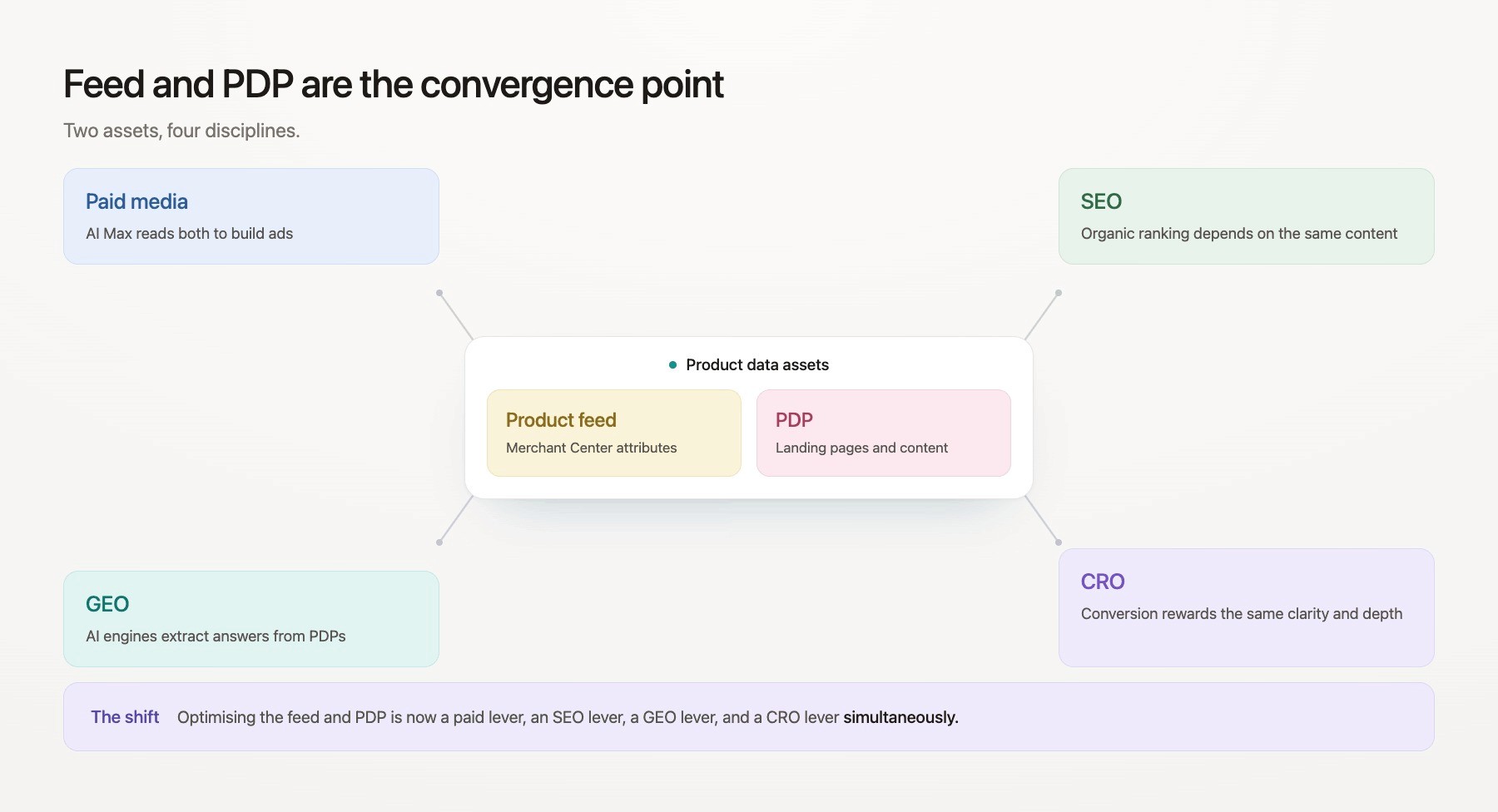
A well-built product page does several jobs simultaneously. It answers a specific intent clearly enough to rank organically. It structures content for AI extraction so it appears in generative search recommendations. It carries rich schema and attribute signals for paid matching. And it aligns with the feed so Google sees a consistent, coherent product rather than a fragmented one.
Most ecommerce teams are not structured to own this convergence. The feed belongs to the digital team, the PDPs belong to marketing, and structured data belongs to nobody. The brands that get this working as one brief rather than three separate workstreams will pull ahead of those that do not.
Where Glara fits
Glara works at the product data layer that AI Max draws from. For ecommerce brands already using Glara to track and improve their AI visibility in organic search, the product data improvements that lift your brand's appearance in ChatGPT and Perplexity are the same improvements that strengthen your AI Max performance in Google Shopping.
The Optimizations Agent identifies the specific gaps in your product descriptions, structured data, and attribute completeness at SKU level and generates the fixes automatically. As AI Max expands to Shopping, the brands with the most complete, specific, and agent-readable product data across their catalogue will see the strongest results. That is not a paid media problem. It is a product data problem, and it is one that can be addressed now before AI Max is live on Shopping.
What to take from this
AI Max success will not be decided by how well your paid team manages bids. It will be shaped by how well the product data foundations were built before the feature was switched on. The brands already treating product data as a strategic asset, rather than a hygiene task, are the ones positioned to get the maximum benefit.
The same work that improves your organic AI visibility improves your AI Max performance. They draw from the same source.
This post was inspired by an excellent piece from Benoit Legendre, Paid Media Director at Novos, a Glara partner. For the full paid media perspective including the AI Max feature breakdown and campaign-level recommendations, read the original post here.
Want to see where your product data stands today? Book a demo and Glara will show you exactly which attributes are missing and what to fix first.

Start your free 7-day trial or book a demo to see how leading brands are winning in AI search.