How AI search behaves across product categories
Before answering a product question, AI runs its own background research. The searches it chooses are sharply different by product category. We ran 979 prompts across skincare, supplements, fashion, footwear, and seven other categories to find out exactly what AI looks for in each one, and what that means for how your brand shows up.
Alex Linewitsch, CPO
|
In hundreds of conversations with our ecommerce customers I get asked this question over and over. For a long time I did not have a fully detailed answer. I had hunches, some partial readings, but nothing rigorous enough to be useful. So I set out to change that.
There is plenty of research on how AI agents behave in general. There is much less on how they behave when they look for your specific product category. So we ran the experiment. We took 979 problem-oriented product questions across 11 product categories, fed each one to Gemini, and recorded both the searches AI ran and the websites it cited along the way.
Three things stood out.
First, before AI commits to an answer, it almost always pauses to do a little background research. The kind of background research it does is sharply different across product categories. Second, Reddit and YouTube are the universal source pillars for most product categories, but one breaks the pattern entirely. Third, each product category has a recognizable third kind of source beyond Reddit and YouTube. Sometimes specialist reviews. Sometimes editorial media. Sometimes medical authorities.
The rest of this post unpacks what we found, with examples from different product categories, and what to do about it.
How we ran it
We took 979 problem-oriented user questions across 11 product categories: skincare, supplements, footwear, knitwear, backpacks, kitchen appliances, eye makeup, hair care, jeans, jewelry, and perfumes. About 20 prompts per category came from real Reddit threads we scraped as anchors. The rest were voice-matched variants we generated to broaden coverage and avoid skewing toward any one subreddit's tone.
Each prompt went to Gemini 3.5 Flash. Google released this model at I/O on May 19, 2026, and it has since become the default model for AI Mode in Google Search, globally. Google also merged AI Mode and AI Overviews into a single experience in that same release. So this is, effectively, the model behind most product questions a shopper now asks Google. The findings here are about Google's current default shopping brain, not AI search in the abstract.
We turned on Google Search grounding for every call. Grounding just means: before answering, the model is allowed to run web searches and read the results, instead of relying only on what it learned during training. The grounding metadata exposes the exact searches the model issued, which we saved.
Of the 979 prompts, 747 (76%) caused Gemini to actually run searches before answering. From those grounded answers we pulled about 2,200 background searches and roughly 9,800 source citations.
What fanout queries are, with one real example
Imagine you ask a knowledgeable friend for an overnight face mask recommendation. Before they answer, they quietly Google a few things. They check Reddit for opinions. They glance at a review site. They open a couple of product pages. Then they tell you what they think.
That is, in a simplified form, what AI does when you ask it a product question. Before committing to an answer, the model often pauses and says, in effect, "ok, to answer this well let me check a few things first." Then it runs a handful of Google searches in the background. Each one of those searches is called a fanout query. Most users never see them. They are AI showing its work, in its own words, by telling you what it considered worth checking before it spoke.
Here is one prompt from the dataset. A user asks Gemini: what's a good overnight mask that actually hydrates the skin well?
The user wrote nothing about brands. Nothing about evidence. Nothing about dates. Gemini ran these six background searches anyway:
best overnight hydrating mask dermatologist recommended 2025 2026
best sleeping mask dry skin intense hydration reddit editor choice
"Youth to the People Superberry Hydrate + Glow" reviews overnight hydration
"Summer Fridays Jet Lag Mask" reviews overnight hydration
"Sulwhasoo Overnight Vitalizing Mask" reviews overnight hydration
"COSRX Ultimate Nourishing Rice Overnight Spa Mask" reviews
Notice what Gemini brought into its research that the user never wrote. Dermatologist recommended. 2025 2026. Four brand names. Reddit editor choice. Dry skin.
One question, six background searches, a dozen new terms. The answer the user eventually saw was shaped by what Gemini found across those six checks, not by the bare words of the original question.
What AI adds to your prompt
We did the same comparison across all 747 grounded prompts. For each one we asked: which words appear in the fanout queries that did not appear in the user's original prompt? Those are the terms AI brought to the research on its own. Then we aggregated per product category and counted: in what share of grounded prompts did each added term show up?
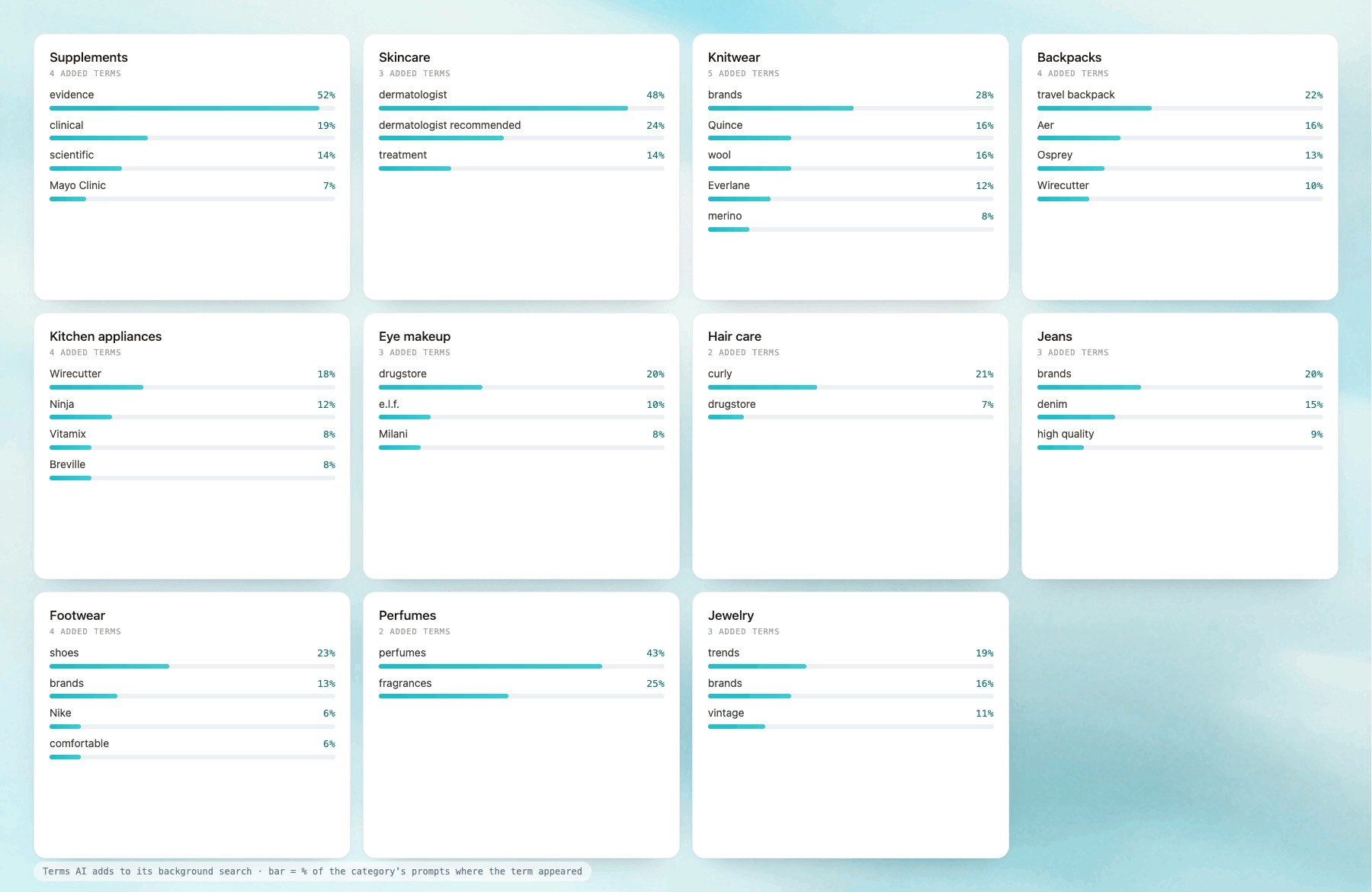
How to read it: each percentage shows the share of that product category's grounded prompts where AI added the term to its background searches, even though the user never wrote it. In 52% of supplement prompts, Gemini added evidence. In 16% of knitwear prompts, it added the brand name Quince. In 13% of backpack prompts, it added Osprey.
One additional note: Sometimes the added term is just the category label itself (like perfumes, fragrances, shoes). That usually means AI is normalizing the shopper’s wording. For example, someone uses “fragrances” in their prompt and AI then rewrites it as “perfumes”.
So what do you do with this?
A few practical things.
Yes, having the relevant vocabulary on your product pages and content does help. AI does match against the words it finds on a page, and content that misses its category's core vocabulary leaves a real signal on the table. So if you sell knitwear and your page never mentions wool, merino, or cashmere, that is worth fixing.
But you will get more out of these terms if you treat them as topic briefs rather than as a keyword list. Each added term tells you what AI thinks the conversation in your product category is about. The bigger play is to genuinely connect your brand to that conversation.
Take backpacks. Gemini adds travel backpack in 22% of its background searches and the brand Aer in 16%. Writing "travel backpack" on your product page helps a little. The bigger move is to be unmistakably a travel backpack. Show carry-on dimensions. Show the laptop sleeve and what laptop sizes fit. Show the lay-flat opening, the hidden security pocket, the structured handle. The page stops being labeled "travel backpack" and starts being one. Now it is in the same comparison set as Aer in the eyes of AI, not orbiting around it.
Take knitwear. Gemini adds wool, merino, and cashmere across many searches. The thin version is dropping those words into the product description. The fuller version is to talk concretely about the yarn: where it is sourced, what gauge and ply, how it was spun, why it feels and drapes the way it does. Pages that do this read as actually being about wool. Pages that just say "made with wool" do not.
Take footwear. AI consistently adds activity, fit, brand. A page that says "great running shoe" does almost nothing. A page that names the kind of running (road, trail, marathon, recovery), the kind of foot (wide, narrow, high-arch, neutral), and the kind of runner (beginner, returner, seasoned) tells AI that the page actually understands the topic. That is the page that gets picked up.
The pattern repeats across every product category. The added terms tell you what AI thinks the conversation is about. Your job is to be in that conversation.
This is also the problem we work on at Glara. It reads what AI expects in your product category and turns it into product-description and structured-data updates you can push straight to Shopify with one click.
Which sources AI looks at in your product category
We also captured every website Gemini cited in its grounded answers. The 747 grounded prompts produced about 9,800 source citations. Here is where those citations came from per product category, with the specific named sources beyond Reddit and YouTube.
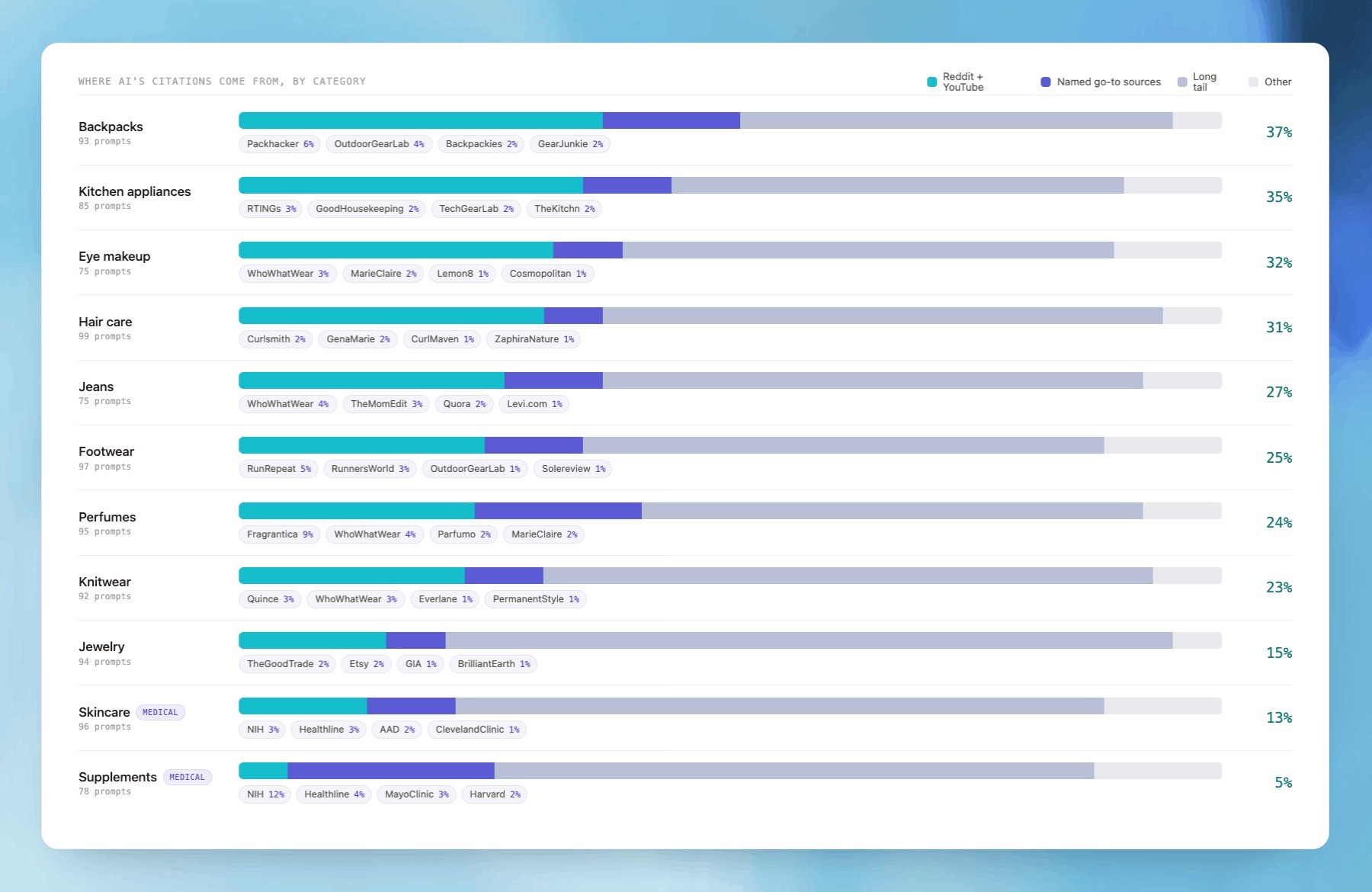
Long tail = the fragmented mass of individual brand sites and niche blogs, each cited only once or twice.
A few things to pull out.
Reddit and YouTube lead by a wide margin in 10 of the 11 categories. Supplements is the one exception: Reddit and YouTube hold just 5%, while NIH alone is cited 111 times across 73 grounded prompts, more than both combined. Skincare comes closest to that shift, with Reddit and YouTube at 13% and NIH, Healthline, AAD, and Cleveland Clinic together at 9%. The social pillars still lead, but by the narrowest margin in the dataset.
Beyond Reddit and YouTube, every category has its own go-to sources, and that is the actionable bit. Backpacks point to Packhacker, OutdoorGearLab, and GearJunkie. Kitchen appliances to RTINGs, GoodHousekeeping, TechGearLab, and TheKitchn. Footwear to RunRepeat, RunnersWorld, and Solereview. Jeans to WhoWhatWear and TheMomEdit. Knitwear to Quince, WhoWhatWear, Everlane, and PermanentStyle. Perfumes to Fragrantica, which does the work of a third pillar on its own at 9%. Skincare to the medical authorities, and supplements to the medical and academic ones above all: NIH, Mayo, Harvard.
The long tail is large in every category, from 44% to 74%. That is not randomness. It means individual brand sites and niche blogs do get cited, as long as they sit in the right kind of source for the category. There is real room to become one of those incremental cited sources if your content fits.
So the practical move is to know which specific sources rule your category. For a backpack brand, earning a Packhacker review or an OutdoorGearLab roundup is structurally more valuable than another keyword-tuned product page on your own site. For a supplements brand, the equivalent is being referenced in a study indexed by NIH or mentioned by Mayo. AI has already decided which sources count. The play is to be on their pages, not to compete against them.
The table above is the category-level picture. Inside Glara you get the same view for one brand: which sites AI cites when it mentions you, broken down by type. That turns the generic list into your list, and shows where the gaps are.
What to take from this
Key learnings:
Before answering a product question, AI usually pauses to run a handful of background searches. The searches it chooses to run are consistent within a product category and sharply different across product categories.
Reddit and YouTube are pillars in 10 of 11 product categories. Supplements is the exception, where medical and academic authorities lead. Skincare is the closest any other category gets to that shift without crossing it.
Every product category has its own specific set of go-to sources beyond Reddit and YouTube. Specialist review sites for gear and appliances. Editorial media for apparel and beauty. Medical authorities for skincare and supplements.
Modern AI judges context around a phrase as much as the phrase itself. Adding category vocabulary to your pages helps a little. Backing it up with substance helps a lot.
The structural moat is being cited on the specific sources that rule your category.
How to use it:
Look up your product category's added-terms list in the added-terms table above. Those are the topics AI thinks the conversation in your category is about, even when shoppers do not say them out loud.
Substantiate those topics on your product pages. Not just contain the words, but actually be about them. Specs, named experts, linked studies or real use cases.
Identify your product category's named go-to sources in the sources table above.
Build a PR and earned-media plan around landing on those sources. Reviews, mentions, expert quotes and guest contributions.
Measure the impact. This is a lot to do by hand, so tools like Glara can help with the work and track whether your visibility actually improves after you ship changes.

Create an account to track your AI visibility and start your 7-day free trial once setup is done.