Does paid editorial actually help AI search visibility?
Paid editorial in trusted publications is one of the more debated levers in AI search visibility right now. It can work. The question worth asking is whether it should be a strategy or just a short-term move.
Glara Team
|

A feature in a respected publication has always been a way to influence perception. A mention in GQ or Haper’s Bazaar, a sponsored review in a category authority site, or coverage in a trade publication signals credibility to a human reader. Increasingly, it appears to signal credibility to AI models as well.
We recently discussed this question with a group of ecommerce and marketing leaders, and it surfaced as one of the most practical and contested topics in the room. Is paying for editorial coverage a legitimate lever for AI search visibility, or is it a shortcut that will not hold up?
The short-term case: it works
Paid placements in publications that AI models already treat as authoritative sources can influence what gets cited when AI assistants generate product recommendations. If a publication is already a trusted source in your category, content associated with your brand on that domain carries some of that trust by association, whether the content is paid or organic.
For brands trying to move the needle quickly, this is a real and usable lever. It is faster than building structured product data from scratch, and it can produce visible movement in AI citations within weeks rather than months.
The longer-term concern: sustainability
The group's view was less optimistic about how long this advantage lasts. There was a clear parallel drawn to early SEO. In the early days of search engine optimization, tactics that worked because the algorithm had not yet learned to detect them eventually got penalized once it did. Keyword stuffing, link farms, and thin affiliate content all had a window where they worked, and all eventually stopped working as search engines got better at detecting manipulation.
The expectation in the room was that AI models will follow a similar trajectory. Models are already capable of detecting structural signals like "sponsored", "paid partnership", or "advertisement" labeling within content. As AI search matures and the commercial incentives around it become better understood, it is reasonable to expect AI platforms to start discounting or flagging paid content the way search engines eventually penalized manipulative SEO tactics. This is not confirmed behavior yet, but the directional risk was something the group felt strongly enough about to flag as a planning consideration, not just a hypothetical.
What is more durable: third-party validation that is harder to fake
The signal the group felt would hold up better over time was independent, organic third-party validation. Genuine reviews from real customers. Guest posts and mentions from trusted voices in a category who were not paid for the placement. Coverage that exists because a publication or reviewer found a product genuinely worth covering.
The reasoning is straightforward. This kind of content is structurally harder to fake at scale, and it reflects something closer to what AI models are actually trying to approximate when they decide what to recommend: a genuine signal of quality and trust, not a paid relationship.
The real tension: short-term hacks versus durable infrastructure
This question sits inside a
broader tension that came up throughout the focus group discussion. There are levers that move visibility quickly and levers that build a defensible position over time, and they are not always the same thing.
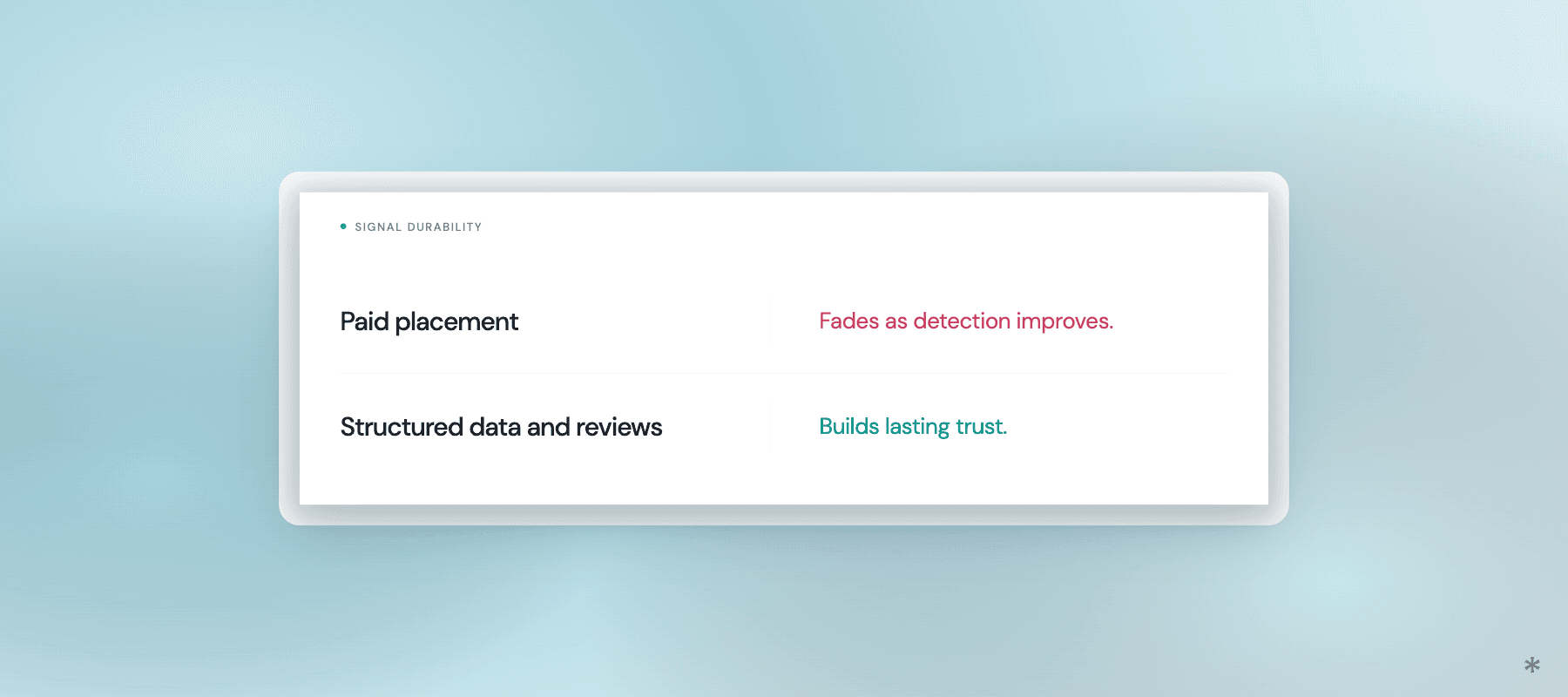
Paid editorial sits closer to the quick-win end of that spectrum. It can work, and it can work soon, but it depends on a current gap in how AI models evaluate sources, a gap that is likely to close.
Structured product data, accurate technical specifications, comprehensive FAQs, and genuine third-party trust sit closer to the durable end. They take longer to build and do not produce the same immediate spike, but they are not dependent on AI models failing to detect a tactic. They are simply giving AI assistants better, more legible information to work with, which is unlikely to ever stop being valuable regardless of how AI search evolves.
What this means for your strategy
The practical takeaway from the discussion was not that paid editorial should be avoided. It is that it should not be treated as the strategy. If a paid placement in a relevant, high-authority publication is within reach and the cost makes sense, it can be a reasonable short-term lever, particularly for newer brands trying to establish initial visibility quickly.
But it should not come at the expense of the structural work: clean, complete product data, accurate technical specifications, and earning genuine third-party coverage and reviews. That is the infrastructure that AI search will continue to reward as the channel matures, regardless of how the algorithms around sponsored content evolve.
Glara helps brands focus on the durable side of that equation. The Optimizations Agent identifies and fixes the structural gaps in your product data that limit AI legibility, and the Attribution feature shows you exactly which attributes AI is already crediting to your brand and your competitors, so you know where genuine content gaps exist versus where you are simply waiting for third-party trust to build.
Want to see where your brand currently stands in AI search? Get your free AI brand report.

Start your free 7-day trial or book a demo to see how leading brands are winning in AI search.