AI search has killed the channel silo
AI search reads your product feed, your site content, and your brand signals all at once. If they don't tell the same story, your products disappear from the results that matter. This post, originally published by Benoit Legendre at NOVOS, breaks down why the channel silo is dead and what to do about it.
Benoit Legendre, NOVOS
|

This post was originally published by Benoit Legendre, Paid Media Director at NOVOS, on the NOVOS AI Search Knowledge Substack. We're sharing it here with permission as it directly relates to how AI is reshaping ecommerce search.
For years, eCommerce brands have treated their marketing departments like separate, disconnected kingdoms. The creative team works in a visual vacuum, the paid search agency manages keywords on an isolated spreadsheet, the SEO team focuses strictly on blogs, and product data is left as a dry afterthought for tech operations.
If you are running that playbook today, you are actively burning your margins.
In this era of algorithmic, content-driven ad platforms and conversation-based search engines, the silos between SEO, GEO, Paid Search, Creative, and Product Data must be entirely demolished. They are no longer separate, independent channels. They are tightly dependent components of the same system. If your asset production and your backend product data are not speaking the same persona language, the loop breaks, and your brand quietly disappears from search results.
Here is the strategic blueprint to building a closed-loop growth engine that dominates modern AI search, based on the frameworks from our recent webinar.
The brands winning in 2026 aren't spending more, they are running better systems
Generating Demand with Meta Andromeda
To understand why traditional funnels are fracturing, you have to look at how top-of-funnel discovery has evolved over the last year. Audience demographic configuration and manual interest selection are becoming obsolete. With the rollout of Meta’s Andromeda algorithm, the platform utilises advanced probabilistic AI models to analyse your actual ad creative and decide who to dynamically serve it to.
The new reality: Your creative asset is your targeting mechanism.
If your team uploads the same core creative concept 20 times with minor, surface-level text changes, Meta’s algorithm recognises it as a single identity. It triggers immediate creative fatigue, fragments your spend, constricts your audience reach, and sends your CPAs soaring.
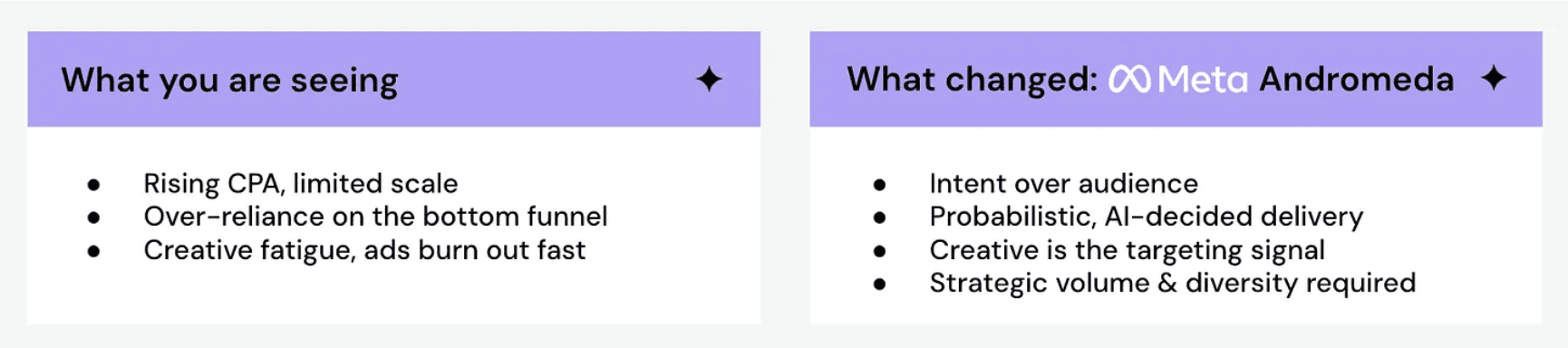
Winning the top-of-funnel today requires true Creative Diversity. Brands must implement a systemised creative loop (Plan, Produce, Test, Learn) that feeds Meta a constant stream of distinct visual angles.
This means blending authentic creator content (to build consumer trust) with AI production tools to scale vertical variations and unique hooks cleanly without an agency-sized production bill.
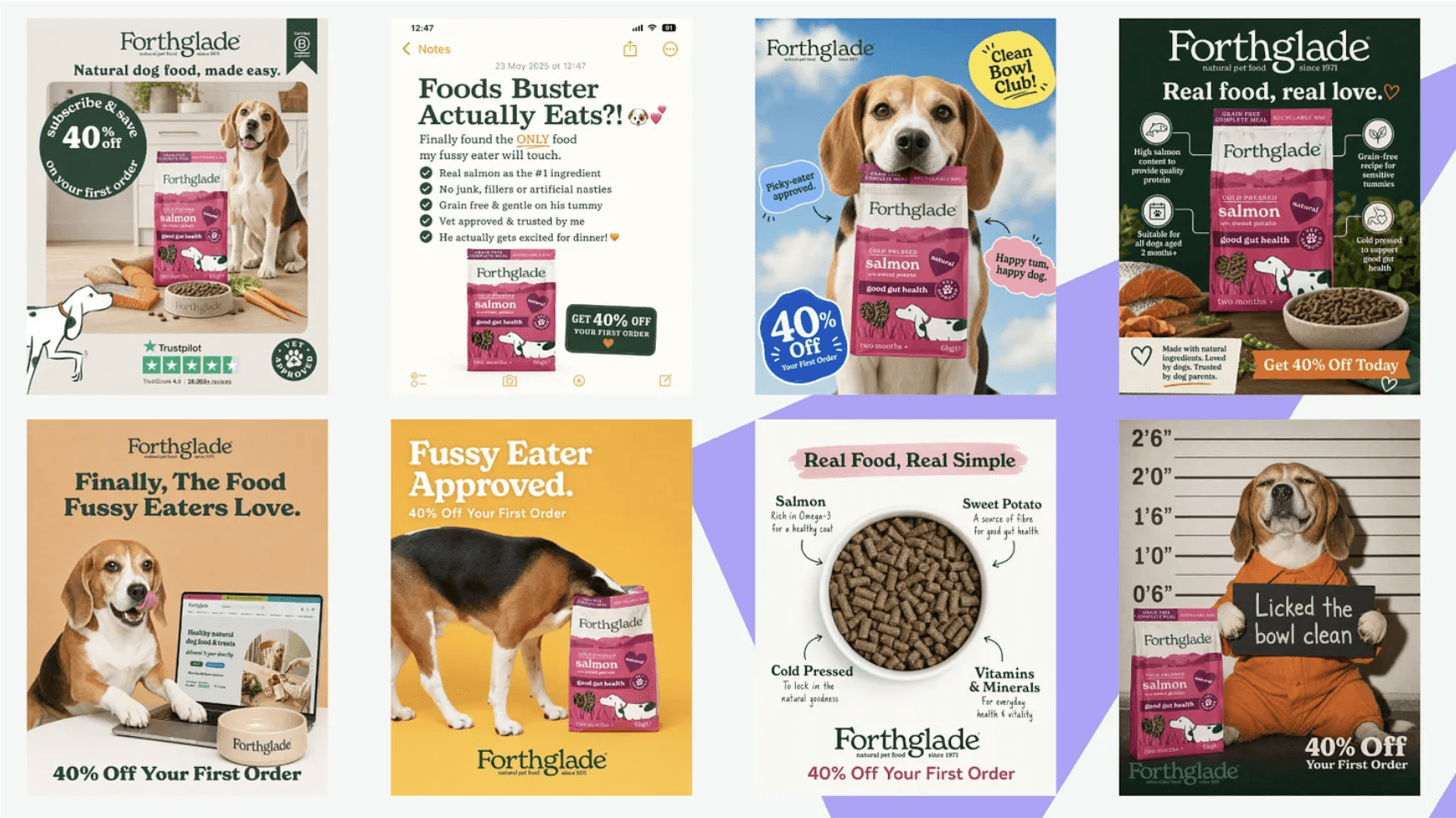
Looking at the Forthglade cold-pressed salmon SKU examples above, generated with NOVOS Studio’s proprietary static ad generation tool, you can see how a single product can be placed into a range of distinct visual contexts. For Meta’s Andromeda algorithm, each variation may function as a different creative entry point, helping the same item reach different audience pockets.
Capturing Demand via Google AI Max & GEO
Generating high-intent demand on paid social media is only half the battle. If your capture mechanisms are siloed, you are simply paying to send traffic away.
Modern search has fundamentally transformed. Consumers are no longer typing simple, broad keywords into a box; they are asking highly granular, natural-language, long-tail questions.
To capture these high-intent buyers, Google relies heavily on AI Max and Performance Max (PMax) to algorithmically route conversational outcomes. But AI Max does not work without context. It acts as a matchmaking engine that requires an integrated foundational architecture of traditional SEO, GEO (Generative Engine Optimisation), Site Content (PDPs), and your Product Feed.
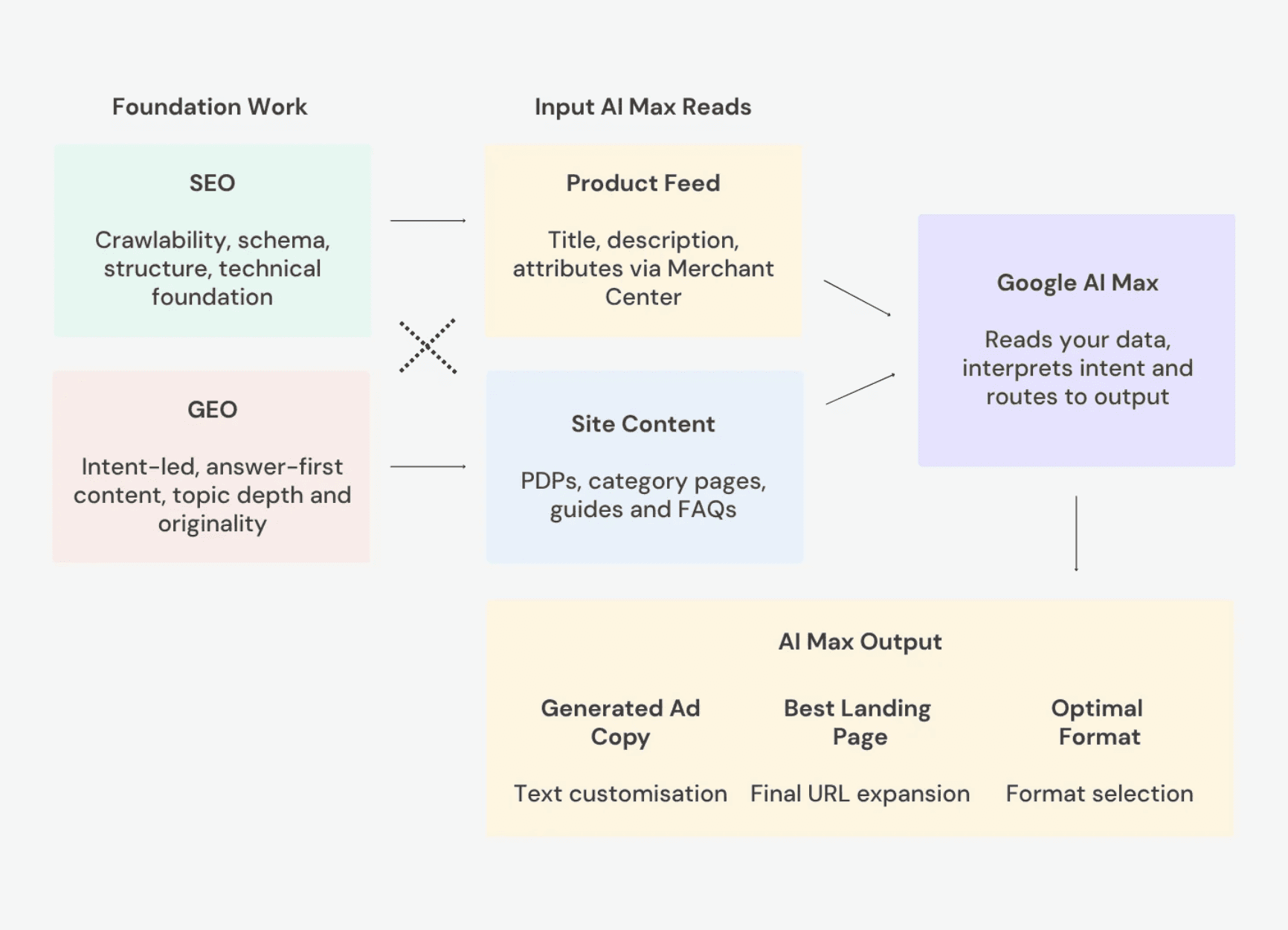
If your SEO team optimises your website PDPs, but your product feed is generic, Google’s AI cannot reliably bridge the gap. You will quietly lose conversions to competitors whose data ecosystem is entirely unified.
(Performance Tip: Stop bleeding margin by over-spending to protect your own brand keywords on Google Search. Manage your brand campaigns down to a clean 70% to 80% Search Impression Share. Anything above 80% yields heavy diminishing returns, and you can never reach 100% anyway. Reinvest that freed-up capital into other areas like your Non Brand campaigns or creative engine instead.)
The AI-Ready Feed Blueprint
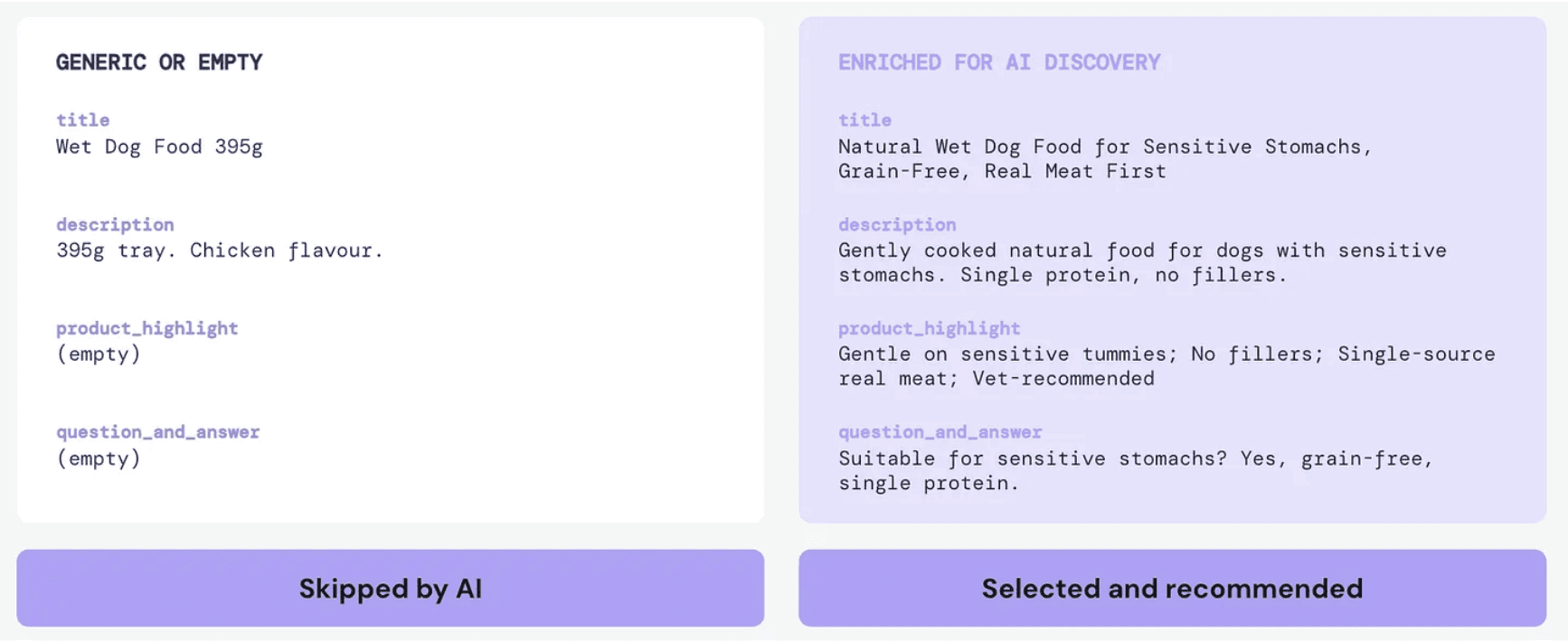
A basic product feed with only a title, price, and stock status is no longer just an operational limitation. It creates a major data gap.
Poor product data leads to “silent drops.” When a feed relies on thin descriptions, missing attributes, and generic copy, products can quietly disappear from next-generation conversational auctions in AI Mode and Search, including the new ad formats expected later this year.

To fix this, your product data must match the semantic depth of your creative strategy.
Following the monumental Google Merchant Center updates, merchants can pass deeply complex, structured contextual information directly into their backend data schemas.
If you want your brand to be cleanly indexed by modern conversational AI search assistants, you need to map these exact fields at a SKU level.
The Rule of Coherence
Modern AI search systems do not look at just your website or just your product list by themselves. They check both at the same time to make sure they match.
True optimisation in 2026 requires coherence. The hook running on your Meta ad, the text on your PDP, the search optimisation on your site, and the conversational attributes in your backend product feed should all communicate the same persona.
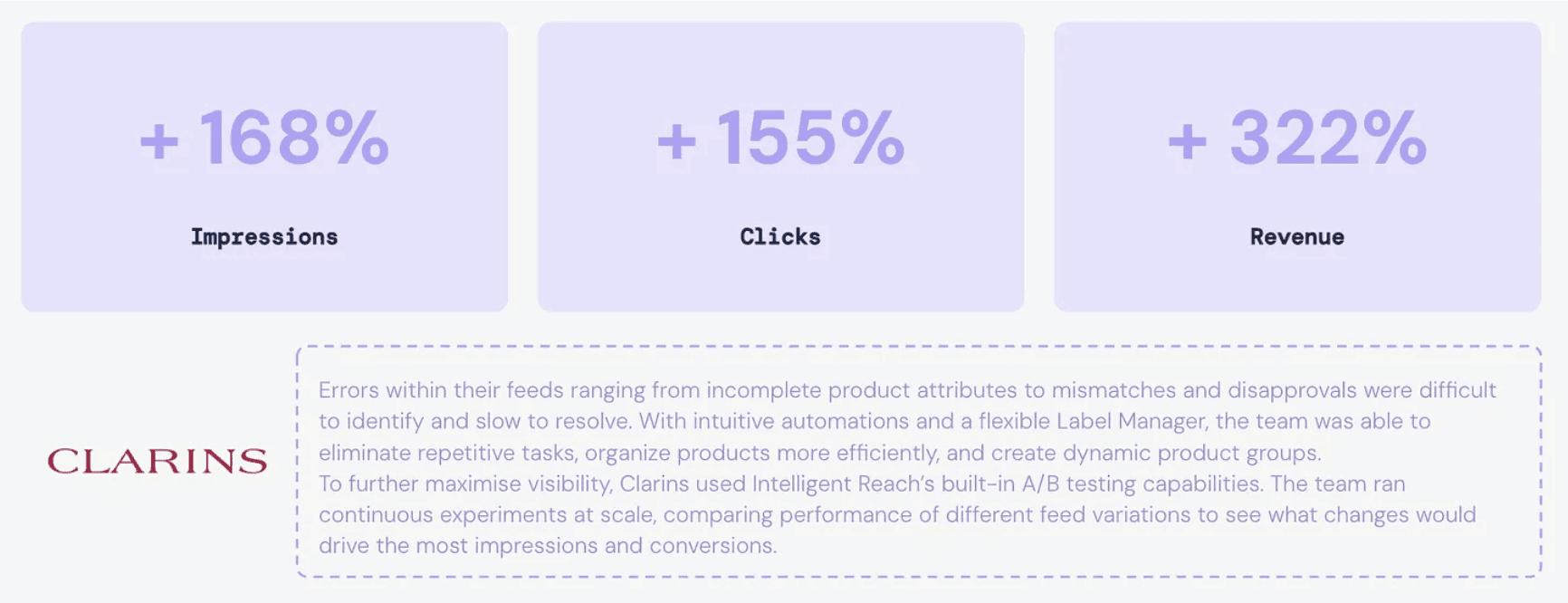
When your entire data stack is unified, the results are undeniable. Take a look at the Clarins Case Study from the webinar: by utilising advanced feed optimisation and automated product attribute mapping, they eliminated repetitive tasks and unlocked search volume. Athos Commerce is the feed management platform that helped them achieve these results. This framework resulted in a +168% increase in impressions, a +155% increase in clicks, and an explosive +322% increase in revenue.
See where your brand stands in AI search, free.
If you're not sure how your products appear in ChatGPT, Gemini, or Perplexity, or whether your product data is structured well enough to be recommended consistently, we can show you.
Get a free AI visibility report for your brand. We'll show you where your products appear across AI search engines, how you compare to competitors in your category, and where the biggest gaps are.

Start your free 7-day trial or book a demo to see how leading brands are winning in AI search.