Why your AI search revenue is probably higher than your analytics show
Most ecommerce brands now accept that AI search is driving some of their revenue. The harder question is how much, and almost every standard analytics setup is structurally unable to answer it accurately. This piece covers why, how post-purchase surveys close the gap, and how Glara's Klaviyo integration makes it straightforward to build a more accurate picture of what AI search is actually contributing to your revenue.
Glara Team
|

Why your AI search revenue is probably higher than your analytics show
There is a number sitting in your analytics right now that is almost certainly wrong. It is the revenue attributed to AI search, and for most ecommerce brands it is significantly lower than what AI search is actually contributing.
This is not a data quality problem. It is a structural one, and understanding it matters more as AI search grows from a marginal channel into a meaningful source of new customer discovery.
The last-click problem
Most ecommerce attribution models, and the default settings in Google Analytics, attribute a sale to the last touchpoint before conversion. If a customer clicks a paid search ad and buys, paid search gets the credit. If they come back directly and buy, direct gets the credit.
This model was built for a world where discovery and conversion happened close together and in a linear sequence. AI search breaks that assumption in a specific way.
When a shopper asks ChatGPT to recommend a moisturizer for sensitive skin, reads the response, notes two or three brand names, closes the chat, and then searches Google for one of those brands three days later, the eventual conversion gets attributed to branded search or direct. The AI discovery moment that put the brand on the shopper's radar disappears entirely from the attribution picture.
This is not an edge case. It is increasingly how a significant portion of considered purchases begin, particularly in fashion, beauty, FMCG, and health and wellness, where shoppers use AI assistants to research and narrow down options before they ever visit a brand website.
Why this matters for how you invest
The practical consequence is that brands making channel investment decisions based on last-click attribution are systematically undervaluing AI search and overvaluing the closer-to-conversion channels that capture the credit for discovery that happened elsewhere.
A CMO looking at their channel mix sees branded search performing well, direct performing well, and AI search contributing a small number. The temptation is to invest more in what appears to be working and treat AI search as a secondary concern. But if a significant portion of those branded search and direct conversions were initiated by an AI recommendation, the real story is the opposite: AI search is one of the highest-value discovery channels in the mix, and it is being starved of investment based on data that cannot see it.
This is the conversation that matters for ecommerce leaders right now, not whether AI search is growing (it is), but whether your measurement infrastructure is accurate enough to make good decisions about it.
What post-purchase surveys actually reveal
The most direct way to close the attribution gap is to ask customers how they found you. Post-purchase surveys are not new, but they have taken on new relevance as AI search has grown, because they capture the discovery moment that click-based attribution misses entirely.
When brands add a simple "how did you hear about us?" question to their post-purchase flow and include AI assistants like ChatGPT, Perplexity, and Gemini as options, what comes back consistently surprises them. AI search shows up as a discovery channel at a rate that is meaningfully higher than what their analytics would suggest, particularly among younger shoppers and in categories where product research is more considered.
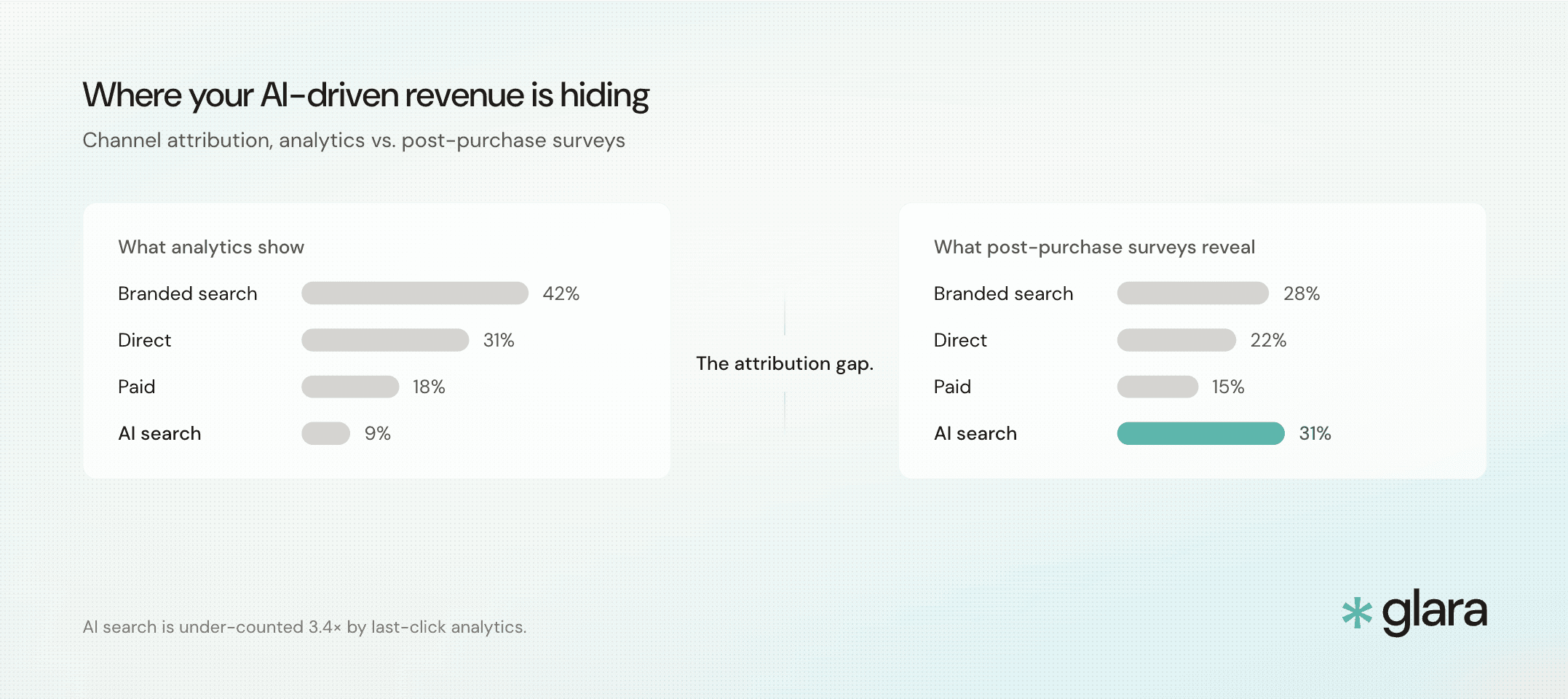
The survey data does not replace click-based attribution. It complements it by showing the discovery layer that click-based models cannot see. Together they give a more complete picture of how customers actually find a brand before they decide to buy.
How the Klaviyo integration helps
Glara now integrates with Klaviyo to make this easier to set up and act on. Connect Klaviyo in Glara under Integrations, add a post-purchase survey to your existing Klaviyo flow with AI search included as a discovery channel option, and as responses accumulate you build a dataset that lets you calibrate your AI revenue attribution more accurately.
The output is two things. First, a more honest picture of what AI search is actually contributing to your revenue, not just what last-click says. Second, a clearer overall breakdown of your discovery channel mix, which tends to surface insights beyond AI search too, including channels that are underrepresented in click-based models for similar structural reasons.
It is a low-friction addition to a flow most brands already have running. The survey does not need to be long or complex. A single question with clear options is enough to start building a useful dataset, and the signal gets stronger as response volume grows over weeks and months.
Combining attribution signals for a more accurate picture
No single attribution method gives the complete picture. Last-click attribution is fast and automatable but structurally blind to discovery. Post-purchase surveys capture discovery intent but rely on customer recall and self-reporting. Glara's direct revenue attribution connects AI visibility data to Shopify and Google Analytics to show which AI-referred sessions are converting and at what rate.
Used together, these three signals give ecommerce leaders something much closer to the truth about what AI search is contributing. Last-click tells you where conversions are closing. Post-purchase surveys tell you where discovery is starting. Glara's revenue attribution tells you which AI recommendations are driving sessions that convert.
For a CMO making the case internally for AI search investment, having all three data points is the difference between a conversation based on incomplete data and one based on a defensible, multi-signal picture of channel contribution.
Where to start
If you are not currently measuring AI search attribution at all, the most useful first step is to understand where your brand stands in AI recommendations today. Get your free AI brand report at glara.ai/ai-visibility-reports to see which products are appearing in ChatGPT, Perplexity, and Gemini for your category, how you compare to competitors, and where the visibility gaps are.
From there, the Klaviyo integration gives you the post-purchase survey layer to start building a more accurate attribution picture alongside Glara's direct revenue tracking.
If you want to understand the broader case for why AI search visibility translates into traffic and revenue, our piece on automatic AI search optimization covers what consistent, weekly optimization does to the numbers in practice. Link below.
Want to see where your brand currently stands in AI search? Get your free AI brand report at glara.ai/ai-visibility-reports or book a demo and we will walk you through your category visibility in detail.

Start your free 7-day trial or book a demo to see how leading brands are winning in AI search.