Automatic AI search optimization: the feature most ecommerce teams have not heard of yet
Knowing your products are missing from AI recommendations is only useful if something happens next. Most AI visibility tools stop at the insight. Glara is built to close the gap automatically, and that difference is the core of what makes it useful for ecommerce teams who do not have a spare sprint every week to action a spreadsheet.
Glara Team
|

Most ecommerce teams now accept that AI search is a real channel. The harder conversation is what happens on a Tuesday afternoon when there are twelve other priorities competing for the same attention, and the AI visibility report from last week is still sitting unopened in a tab.
This is the gap that defines whether AI search optimization actually happens or stays a quarterly intention. Tracking visibility is now relatively straightforward. Several tools, Glara included, will show you which products are appearing in ChatGPT, Perplexity, and Gemini, which are absent, and roughly why. The harder part has always been what comes after the insight, and that is exactly where Glara is different from almost everything else in this category.
Why most AI visibility tools stop short
For most ecommerce teams, acting on AI visibility data means opening a spreadsheet, briefing a copywriter, editing product descriptions manually, updating metafields, pushing changes to your store one product at a time, and then waiting weeks to see whether anything moved. For a catalogue of any meaningful size, that process does not fit into a weekly rhythm. It becomes a project, and projects get deprioritized. The visibility gap stays open while competitors who have found a faster workflow pull ahead.
Almost every AI visibility platform on the market today is built to answer one question: where do you stand? Very few are built to answer the second, much harder question: what do we do about it, every week, without adding headcount.
That second question is what the Optimizations Agent answers, and it is also where AI visibility actually starts converting into revenue. Tracking tells you there is a gap. Optimization is what closes it. This is the diagnose and fix part of how Glara works, sitting right after measuring visibility and right before proving the revenue impact.
What the Optimizations Agent actually does
Glara runs an agentic system weekly that analyzes your AI visibility data and generates a prioritized action list based on revenue relevance and citation importance. Rather than a generic list of suggestions, it identifies specifically which products are underperforming in AI recommendations, what is missing from each one, and generates the fix across three task types.
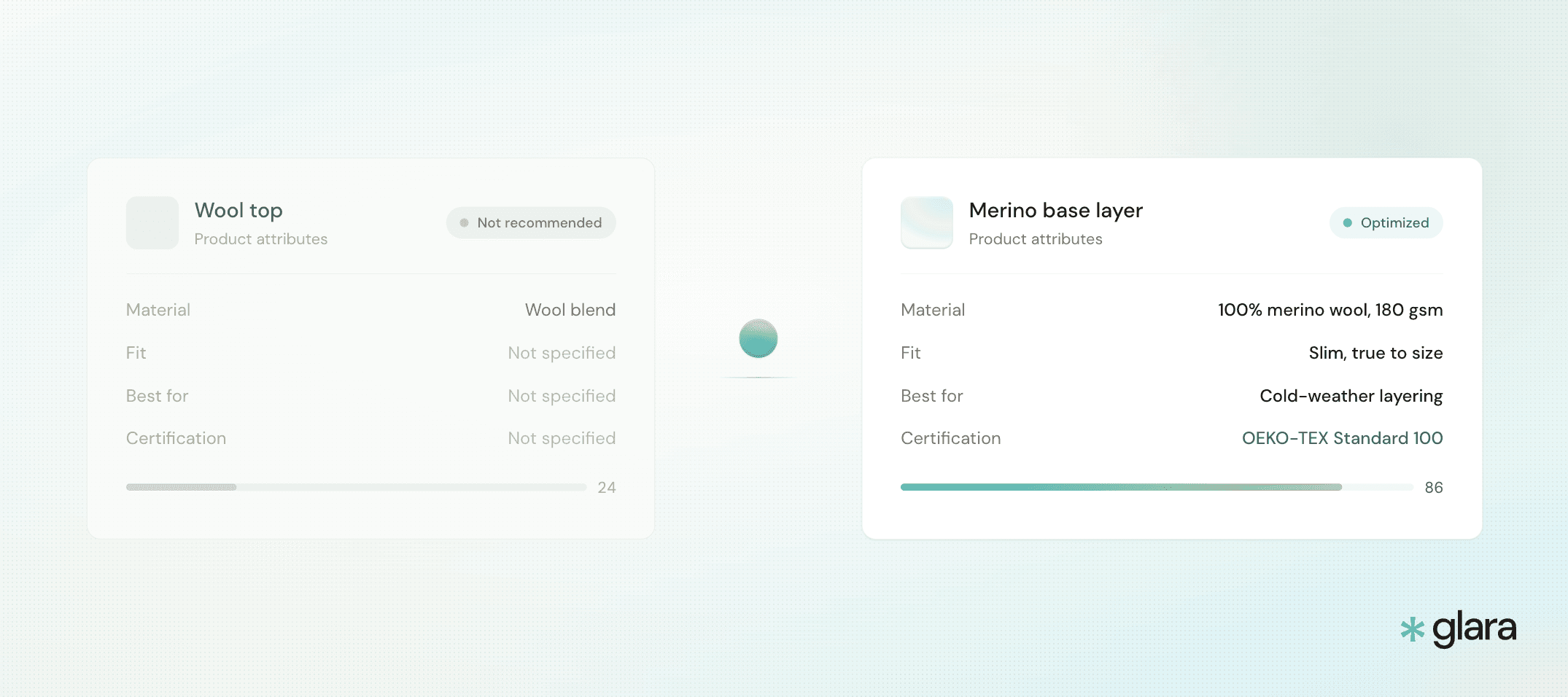
Product descriptions are rewritten to be specific and AI-retrievable, containing the attributes AI agents need to match a product to a query with confidence, while staying aligned to your brand voice. Structured data is generated and deployed so product attributes are machine-readable at variant level, not just product level, which most stores are missing even when basic schema exists. Meta tags, the titles and descriptions invisible to shoppers but read first by AI agents and crawlers, are rewritten from generic to specific.
Tasks are grouped by type and ranked by priority, so a lean team can work through the highest-impact items first without triaging manually. From there, your team has two ways to put the fixes into action. Ask Glara can execute optimizations in bulk directly, so a whole batch of prioritized fixes can be applied in one go. For teams who want optimizations running inside their own tools and workflows, Glara MCP supports the same execution, so changes can be triggered from wherever your team already works. Either way, changes are pushed directly to your store via API. No exports, no developer resource, no back and forth.
Every change is visible and editable before it goes live, and every applied optimization can be reversed in one step if you want to test something and roll it back. Glara also learns from your team's brand guidelines and tone of voice over time, so suggestions stay on-brand without your team having to rewrite them from scratch every week.
Why specificity is the real lever, not writing quality
The reason most strong, well-converting product pages are still invisible to AI agents is rarely about writing quality. It is about specificity.
A description that says "our bestselling everyday moisturizer, perfect for all skin types" tells an AI agent almost nothing it can use. It knows the product is a moisturizer. It does not know the key ingredients, which skin types it genuinely suits, the SPF level, or how it performs for sensitive skin specifically. For a query like "best fragrance-free SPF moisturizer for sensitive skin under £30," that product does not exist in the AI's recommendation set, no matter how well it converts once a shopper finds it through other channels.
A description that says "lightweight daily moisturizer with SPF 30, formulated without fragrance, parabens, or synthetic dyes, dermatologist-tested for sensitive and reactive skin types, suitable for daily use under makeup" gives the AI agent everything it needs to match the product confidently to that query.
The Optimizations Agent is built around closing exactly that gap, automatically, across an entire catalogue rather than one product at a time.
What this looks like in practice
Across fashion, beauty, and FMCG catalogues, the same pattern shows up repeatedly. A fashion brand's hero products are missing fit and fabric specifics at variant level, so structured data fixes are usually the highest-leverage starting point. A beauty brand's content reads well but its meta tags are generic boilerplate, so the fix that moves visibility fastest is often the layer nobody thinks to check first. An FMCG brand launching new products every few weeks needs the optimization cycle to run continuously rather than as a one-off project, since new SKUs without nutritional and certification data become invisible the moment they launch.
The common thread is not that these are different problems. It is that the fix is always the same three-layer process, applied automatically and consistently rather than as a manual one-time effort.
The commercial case: why this is a revenue conversation
For a CMO or Head of Ecommerce, the reason this feature matters more than tracking alone is straightforward. Visibility data tells you where the gap is. It does not close it, and a gap that stays open does not generate revenue no matter how well it is measured.
Glara connects AI visibility directly to traffic and revenue at brand and product level, so the impact of optimization work is measurable, not theoretical. When a product moves from absent to recommended for its core queries, that shows up as AI-referred sessions and conversions you can track against the specific optimization that closed the gap. This is the prove step, and it is what turns AI visibility from a reporting metric into a revenue channel.
The pattern holds consistently across the brands Glara works with. One fashion catalogue saw revenue on optimized products increase 100 percent within 28 days, with traffic up 82 percent overall. A luxury fragrance brand saw optimized products drive 6.5 times more additional traffic than non-optimized products over the same period, with AI visibility up 72 percent versus 37 percent for products left untouched. In both cases, the products were not new, and the underlying pages already converted well. What changed was whether AI agents could confidently match them to a query.
The brands appearing consistently in AI recommendations are rarely the biggest or most established names in their category. They are the ones whose product content is most specific, most structured, and most consistently maintained. Glara's audits across fashion, beauty, and FMCG brands show the same pattern repeatedly: a brand with strong overall visibility can have specific hero SKUs completely absent from the AI queries that matter most, simply because the description is atmospheric, the structured data is thin, or the meta tags are generic. A competitor with less brand recognition but more complete product content wins the recommendation instead.
This is the operational reality of AI search. It rewards consistency and specificity at product level, not brand awareness at category level, and the teams without an automated way to act on their visibility data are the ones watching that gap widen and the revenue go to a competitor.
Where to start
Measuring, diagnosing, fixing, and proving impact is the full loop Glara runs on, and the Optimizations Agent, whether triggered through Ask Glara or Glara MCP, is what makes the fix step automatic rather than manual.
See where your brand stands today with a free AI brand report at glara.ai/ai-visibility-reports, or check the latest category leaderboards to see how your competitors compare. From there, Glara shows you exactly which products have the largest gaps and the highest revenue impact, with the specific fixes ready to review and apply.
Want to see which of your products have AI visibility gaps worth closing this week? Book a demo and Glara will show you exactly where your catalogue stands.

Start your free 7-day trial or book a demo to see how leading brands are winning in AI search.